Colours
Choosing an Iridescent Car Wrap: Colour Shifts, Light, and Panel Shapes
Published
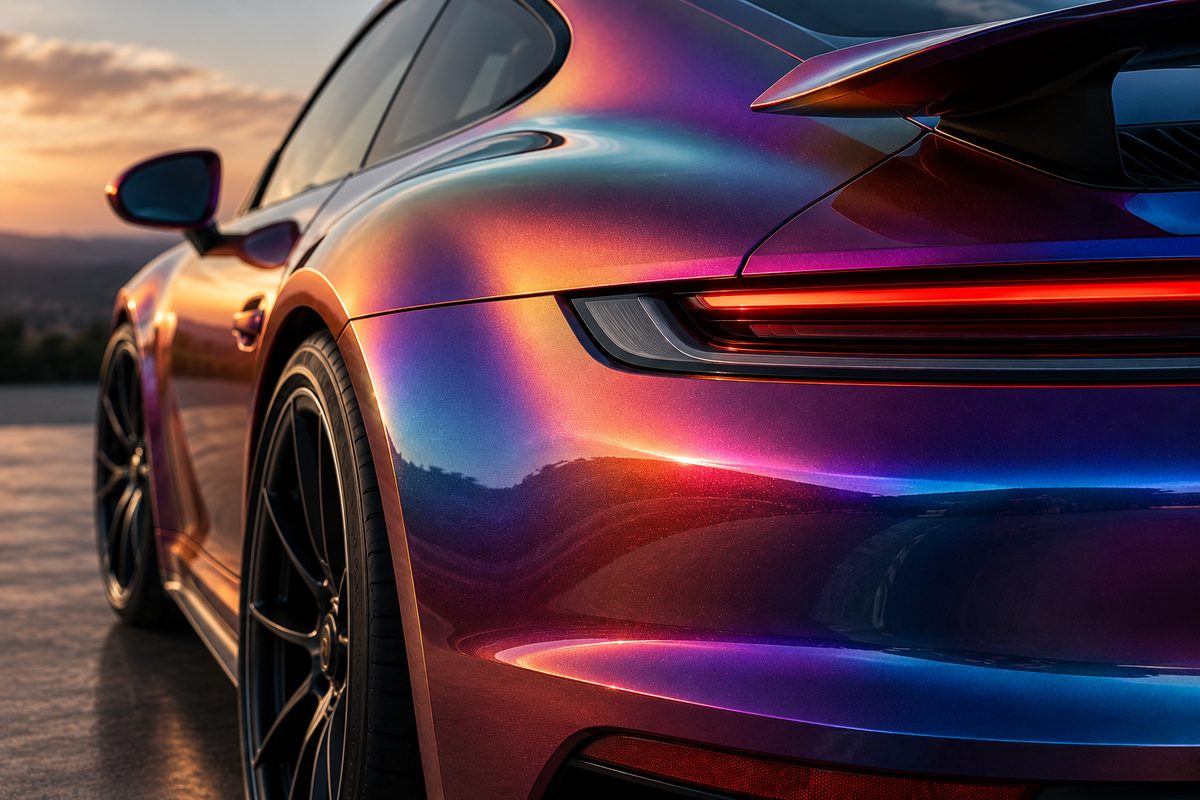
An iridescent car wrap is defined by movement. Unlike solid gloss or flat matte vinyls that maintain an even tone across every panel, an iridescent film changes colour depending on your viewing angle and the light around you. In direct sun, a bonnet might reveal bright highlights of turquoise or gold, while the shadows beneath a swage line deepen into violet, navy, or slate.
Because these materials depend on ambient light and vehicle geometry, choosing one requires a clear understanding of how shift vinyls actually behave on metal and plastic.
Pearlescent vs colorflip: understanding the spectrum
Within vinyl manufacturing, iridescent effects generally fall into two broad camps: pearlescents and colorflips.
Pearlescent finishes use microscopic flakes suspended in the vinyl layers to reflect light at specific wavelengths. The base tone remains the anchor of the vehicle, but a second hue floats across the crests of your curves. For instance, Pearl White (SP10) by 3M 2080 presents an understated white base, but outdoor daylight catches the surface to throw subtle silver and soft golden reflections across the wings and roof. In the WrapUp AI catalogue, there are 72 pearlescent colours across manufacturers like 3M 2080 and KPMF, offering delicate shifts that keep a car looking clean rather than flamboyant.
Colorflip or shade-shifting films take this concept further. These multi-layer films produce a noticeable transition between distinct colour families as you move past the car. In our catalogue, 15 colorflip options provide more dramatic contrasts, moving from deep purples to bright emeralds or warm bronzes across a single door panel.
Whether you lean toward a subtle pearl or a bold transition, the final result depends heavily on the surface finish you select.
The impact of finish on iridescent effects
Finish dictates how sharply an iridescent colour presents its shift.
- High Gloss and Gloss: Across the 210 High Gloss and 188 Gloss colours in the catalogue, the clear top layer acts like clean lacquer. It produces sharp reflections, creating strong contrast between the primary base colour and the shifting highlight. A film like Imperial Orchid (K75468) by KPMF demonstrates this clearly, moving between rich blue and purple with crisp, reflective edges.
- Satin: Satin finishes—accounting for 66 colours in the catalogue—diffuse the reflection. Films like Ocean Shimmer (S327) by 3M 2080 soften the highlight into a smooth sheen. Instead of a hard line of reflection, the shift spreads across the panel in a gentle gradient, making it easier on the eyes across broad surfaces like bonnets and roofs.
- Matte: Matte iridescent finishes are less common but visually striking. With 148 matte colours available, options such as Metro Dynamic Turquoise (K75511) or russet red (K75545) by KPMF show that pearlescent flakes can still work without gloss. In matte films, the light scatter is entirely diffuse. You do not see a bright reflection, but rather an eerie, velvet shift from blue to green or deep red to copper as panel angles change.
Why bodywork lines matter
Iridescent films need curvature to show their strengths. Flat, vertical panels—such as the slab sides of a large van or boxy off-roader—provide few angles for light to refract. On flat surfaces, an iridescent wrap can look like a regular solid colour for most of the day, showing its secondary hue only when the sun sits low on the horizon.
In contrast, vehicles with pronounced body lines, flared wheel arches, or sculpted bonnets bring these films to life. The sharp crease of a shoulder line creates an immediate split: the upward-facing surface catches sky light and shows the iridescent highlight, while the downward-facing surface stays in shadow, showing the deeper base hue. If your car has soft, organic curves, the transition appears seamless and fluid.
Why swatches and online photos fail to show the shift
A small physical swatch booklet held on a shop counter cannot tell you how an iridescent wrap will look across an entire vehicle. A sample measuring a few square inches has virtually no curvature; you can tilt it in your hand under artificial showroom strip lights, but that bears little relation to how acres of vinyl react to an overcast sky or an evening streetlamp.
Looking at photos of other cars online can be just as misleading. A photograph of a sleek sports coupe wrapped in a shade-shifting film tells you very little about how that same vinyl will sit on your five-door hatchback or saloon. Camera sensors often struggle to balance shifting pigments, and post-processing frequently exaggerates the colour transitions beyond what your eyes will see on the street.
Seeing the material at full vehicle scale, mapped against the specific lines and contours of your own car, is the only reliable way to gauge whether a shift is too subtle or too aggressive.
Visualising an iridescent colour on your car
With 626 colours in the WrapUp AI catalogue across manufacturers like 3M 2080, KPMF, and Orafol 970RA, you can test how different tones suit your vehicle before committing to a roll of vinyl.
You can upload a photograph of your own car—sitting in your driveway, car park, or street—and preview real vinyl colours directly on its panels. The visualiser retains your car's actual reflections, panel lines, and ambient lighting, giving you a realistic impression of how shifts in hue will wrap around your bodywork. Keep in mind that a rendered preview is an impression rather than an exact physical colour match, but it provides the perspective and scale that small swatches cannot.
Three renders are free to start, with no account needed. To see how an iridescent shade works on your vehicle's curves, explore the catalogue on the WrapUp AI visualiser.
See any car in any wrap colour — three renders free. Try WrapUp AI