Before you wrap
Car Wrap vs Paint: Aesthetic Differences, Finish Options, and Visual Depth
Published

When weighing up a car wrap vs paint, most drivers focus entirely on the final look. While a respray has traditionally been the default method to refresh or alter a vehicle's appearance, modern cast vinyl films have changed what is visually possible across complex bodywork. Understanding the aesthetic distinctions between a car wrap and fresh paint helps clarify which approach suits your vehicle's specific lines.
The Visual Characteristics of Automotive Paint
Automotive paint relies on layers: primer, base coat, and a clear lacquer. In conventional factory paintwork or high-end resprays, the clear coat provides significant optical clarity. Light penetrates through the lacquer, strikes the pigment flakes within the base coat, and reflects back out. This structure gives wet-look gloss paint its characteristic depth.
However, paint has practical visual constraints. Replicating certain non-gloss surfaces uniformly—such as a true satin or dry matte—can be exceptionally difficult with paint. Matte lacquers cannot be polished or machine-buffed without introducing uneven glossy patches. As a result, achieving an exact, uniform sheen across an entire car with paint requires meticulous control in the spray booth.
The Visual Range of Vinyl Film
Where vinyl distinguishes itself in the car wrap vs paint comparison is the breadth of surface finishes engineered directly into the film. In the WrapUp AI catalogue of 782 colours, finishes range from standard Gloss (273 colours) and High Gloss (208 colours) to Matte (166 colours) and Satin (104 colours), alongside specialised textures.
Modern vinyl films allow for distinct visual effects that are difficult or impossible to produce with conventional paintwork:
- Consistent Satin Sheens: Formulations like Key West (S57) by 3M 2080 or Frozen Satin Snow Blue (FS2024) by Inozetek Vinyl give a soft, metallic glow across body curves without the blotchiness that can occur with satin paints.
- True Flat Textures: Films such as Frozen Matte Volcanic Grey (FM3010) by Inozetek Vinyl or Charcoal Metallic (M211) by 3M 2080 absorb direct glare while tracing character lines sharply along the vehicle's flanks.
- Specialised Shifts and Flips: Colours like Flip Psychedelic (GP281) by 3M 2080 combine grey, blue, and colorflip tones that shift distinctly depending on viewing angle and sky condition—a visual dynamic rare in standard automotive lacquers.
- Deep Metallics: Options like Matte Copper kiss (313M) by Orafol 970RA or russet red (K75545) by KPMF bring pearlescent and warm metallic pigments into uniform matte finishes.
High-gloss cast films, including High Gloss Nardo Grey (HG61) by 3M 2080 or Gloss MIDNIGHT GREEN (MSG023) by Inozetek Vinyl, narrow the visual gap between vinyl and factory lacquer, providing smooth, mirror-like reflections on broad flat panels such as bonnets and roofs.
Why Swatches and Other Cars Mislead
A common mistake when comparing a wrap to paint is relying on a hand-held swatch or an image found online.
A two-inch sample chip lying flat on an indoor counter gives almost no indication of how a colour behaves on a car. In an office or showroom, light comes from point-source overhead bulbs, whereas cars live under open sky, cloud cover, and street lighting. More importantly, cars are not flat sheets of metal. They are made of compound curves, sharp creases, and recessed panels. A shade like Matte Indigo Blue (544M) by Orafol 970RA or Iced Green Titanium (K75507) by KPMF reveals its true character only when light breaks over the crest of a wing or drops into a door recess.
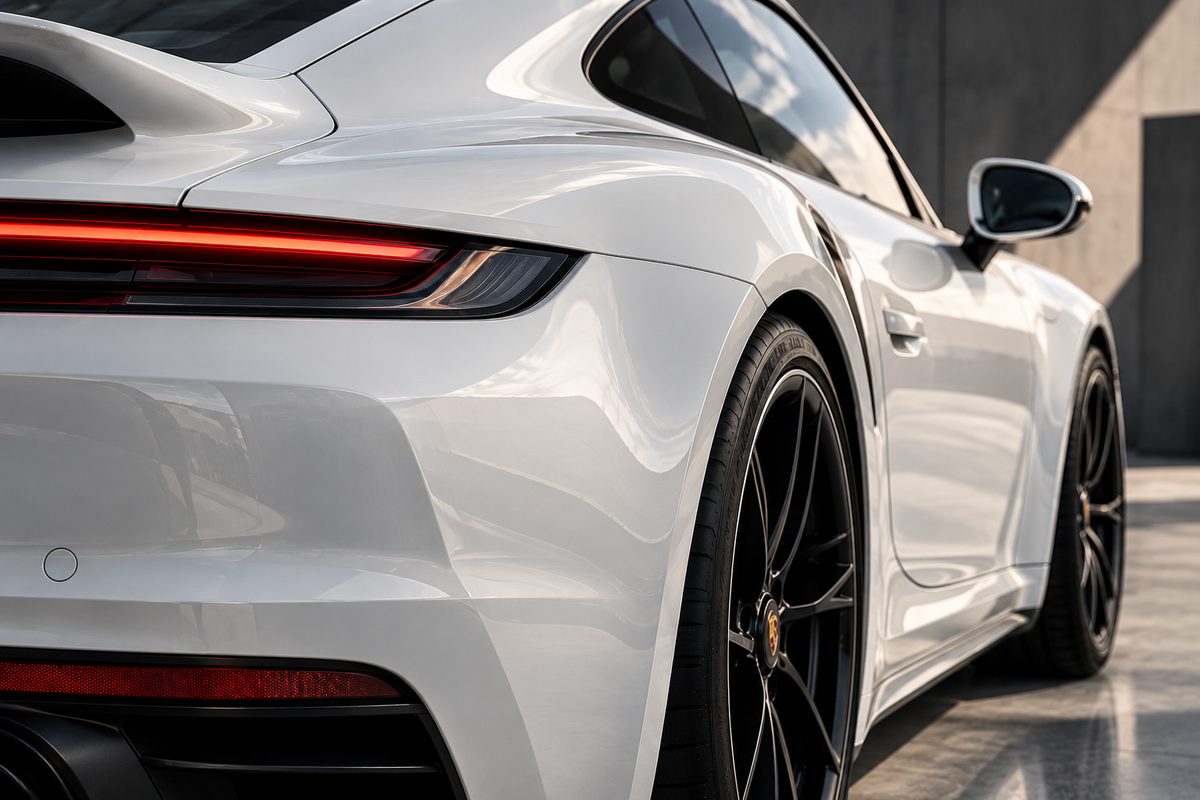
Looking at photographs of someone else's car can be equally misleading. A sports coupe with aggressive, sculpted styling creates dark shadow lines and intense highlights. If you put that exact same shade on a boxy estate or a compact hatchback, the larger vertical surfaces will reflect the surroundings differently. Camera settings, post-processing filters, and ambient reflections often disguise the true tone of the wrap.
Testing Colours on Your Vehicle
To make a confident visual comparison, you need to see how a specific vinyl tone interacts with your vehicle's actual panels, under realistic lighting.
With WrapUp AI, you upload a photograph of your own car in its real setting. You can test shades like Gloss Pearl Tutu Pink (523) by Avery SW900, Lime Green (731) by Avery SW900, or Gloss LIQUID METALLIC CHAMPAGNE (MSG2908) by Inozetek Vinyl directly against your wheels, trim, and body lines.
Keep in mind that a digital render provides an impression of tone and finish rather than an absolute colour match, as screen calibrations and ambient photography affect the display. However, testing the shade on your own car shows you where highlights will collect, how the shadows fold around your doors, and whether a satin or high gloss better complements the car's architecture.
You can explore three renders for free with no account required to begin. Compare your options and see how different vinyl finishes look on your car at WrapUp AI.
See any car in any wrap colour — three renders free. Try WrapUp AI